Private tour package for up to 10 pax - Discover Angkor Wat, Taprohm, Bayon, Bakheng Temple

Let's Ride the Bamboo Train in Battambang

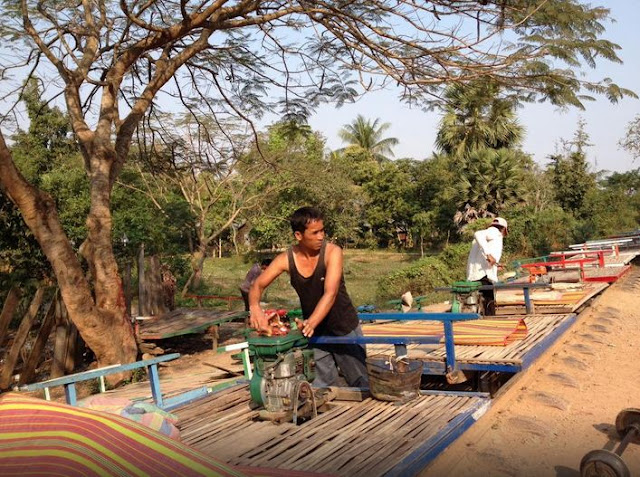
When you are traveling in Cambodia many will for sure ask you about your plans to ride the Bamboo Train! A train without a particular destination…..just a bumpy ride up and down a 12km track passing beautiful and lush green Cambodian sceneries. One of the funniest things to do in the area of Battambang? Or just a show for tourists?
This train (although it is nothing more than a bamboo platform on two steel axles with wheels) is a surviving part of the former Cambodian railway network. No trains are running in Cambodia anymore and most tracks are left to be overgrown with weeds.


In the rural city of Battambang , they are still using a short track of around 12kms. They indeed use it mainly for tourists although some locals also ride the track.


The trains are actually just flat bamboo beds. It feels like a flying carpet on wheels, although it is not as silent as a flying carpet. How fast? Well, around 30km/h.
This close to the ground you will for sure feel every bump in the track (and there are many!), but nothing to worry about. Every train has a driver sitting at the back, making sure the engine keeps on running.


Sadly, the Bamboo Trains will soon stop to exist. In February 2008 a project was announced to rebuild the railway lines from Sihanoukville to Phnom Penh, Phnom Penh to Poipet and on to Sisophon and the Thai border (a stretch completely destroyed by the Khmer Rouge regime). This was due to be completed at the end of 2009. As of May 2011 this project has only completed from Phnom Penh to Sihanoukville.


As of May 2011 the bamboo train appears to be the only train operating around the Battambang area, which can be observed by the completely overgrown tracks passing though the city. On the outskirts a tourist service operates for $5 per person to a village that has a brick factory. This is overseen by the local Tourist Police. Surely, the railway will be upgrade to Phnom Penh again….but until then, go and ride the Bamboo Train!

Popular posts from this blog

Mondulkiri - The Sea Forest of Cambodia

Mondulkiri is Cambodia’s largest, nevertheless least-populated province. the area features distinctive rolling hills, fine country views, wild natural landscapes, jungles, multiple of waterfalls and a unique indigenous culture.  Sen Monorom - Mondulkiri’s city, at an altitude of about 800m above sea level, offers a refreshing break from the heat of Cambodia's lower plains. sen Monorom is found 370km north east of Phnom Penh. Traveling to Mondulkiri is easy now, since the road has been upgraded and paved . This large and quiet province, is one of Cambodia’s most lovely areas, and a beautiful destination to include whilst traveling around Cambodia. Mondulkiri is a rising destination for nature / eco-tourists and there are elephant & wildlife sanctuaries and Eco-tourism projects in the area.

Tonle Sap Floating Villages

Located in Cambodia, Tonlé Sap Lake is the biggest freshwater lake in Southeast Asia. The lake drains into the Tonle Sap River which flows into the Mekong River throughout the dry season. But from June to October, the rainy season, the Tonlé Sap River reverse its flow due to the huge amount of water in the Mekong River. The water flowing into the lake and the backup of the Tonle Sap River increase the lake to 5-times its size in the dry season. This huge increase floods the surrounding floodplain and forests making an implausibly various and rich eco-system. Tonle Sap Floating Villages There are actually many so-called floating villages set on, and around the Tonle Sap Lake and they are all somewhat completely different. The Tonle Sap Lake is the largest feature of the map of Cambodia, and is an important natural resources in terms of fishing and wetlands. In the rainy season, the Mekong River backs up into the lake, and it swells to over five times its size in th...

U.S. supports $1 million for food project to empower Cambodian women

Funding for the $1 million project, titled Women in Agriculture Network Cambodia: Gender and Ecologically Sensitive Agriculture, was awarded by the Feed the Future Sustainable Intensification Innovation Lab, which is based at Kansas State University. The program is supported by the U.S. Agency for International Development as part of Feed the Future, the U.S. government's global hunger and food security initiative. Smallholder farmers produce nearly half of the world's food, but they often have notoriously low yields, strong gendered divisions of labor and limited financial resources, according to lead investigator Rick Bates, professor of horticulture at Penn State. "Small-scale farming systems such as these -- prevalent in many developing countries -- have been called 'very resilient poverty traps' that are characterized by chronic food and nutrition insecurity," said Bates, whose expertise includes horticulture enterprise development and sustainab...